 Worksheet 1.
Worksheet 1.
Antarctic Ice
Read the passage below and then answer the questions following it. The excerpt is from the book Antarctica written by Colin Monteath, an author and photographer who has travelled and worked in the Antarctic for over 20 seasons.
Antarctica covers 10% of the world's surface, an area equal to the USA and Mexico combined. Its harsh environment locks 70% of the world's fresh water into ice sheets, in places over 4 km deep; yet a unique ecosystem supports one of the richest concentrations of wildlife in the world
The modern-day Antarctic ice sheets consist of about 30 million cubic km of ice spread over an area of 14 million square km - nearly twice the size of Australia. Only a smattering of rocky summits and coastal ice-free areas avoid complete inundation by this blanket of ice. Many of Antarctica's glaciers take on enormous proportions. The world's largest glacier, the Lambert, situated near the Australian science bases Davis and Mawson, is 400 km long by at least 100 km wide. The Lambert is further extended where it flows out to sea to form the Amery Ice Shelf. If the weight of Antarctic ice was removed from the continent, the land would rise from 300 m to 1000 m. In fact, Antarctica's incredible mass causes the Earth to be slightly pear-shaped.
Antarctica is divided into the West and East Antarctic ice sheets by the 3000 km long Transantarctic Mountains which are up to 4500 m high. Much of the West Antarctic Ice Sheet rests on bedrock that is well below sea level. The East Antarctic Ice Sheet by comparison is much larger and rests on a base that is predominantly above sea level. Massive ice domes in East Antarctica reach up to 4000 m. The North Pole and surrounding Arctic Ocean are often referred to by geographers and map-makers as the 'top of the world'. In reality, with the Geographic South Pole at over 3000 m and with a mean elevation of over 2000 m, Antarctica is by far the highest of all continents.
In 1995 a single iceberg
measuring 77 km by 37 km and 180 m thick broke away from the Larsen Ice Shelf
to drift northwards into the Weddell Sea. An even larger one, 154 km by 36 km,
cut loose from the Ross Ice Shelf in 1987.
Questions
1.
The
area of New Zealand is 269 000 km2. How many times bigger than New
Zealand in area are the modern-day Antarctic ice sheets?
2.
The
area of the North Island of New Zealand is 115 000 km2. What percentage
of the North Island could the Lambert glacier cover?
3.
Some
people have suggested that countries could obtain fresh water by towing
icebergs from polar regions to their countries. In this problem you will
calculate what sort of water supply could have been obtained from the 1995
iceberg mentioned above.
a) Find the volume of this iceberg in cubic metres.
b) Convert this volume into litres.
c) Suppose that one quarter of this volume gets lost through melting and poor handling of the iceberg and that only three quarters of it is converted to useful fresh water. Suppose further that each person needs three litres of fresh water each day for drinking and cooking purposes. How long would this iceberg last if it was used to keep the entire world (population 4 billion people) in fresh water?
4.
These
days there is much concern about global-warming and how this could affect the
level of the world's oceans. In this problem you will calculate what could
happen to the level of the world’s oceans if the Antarctic ice sheets melted.
The total area of all the world's oceans is 360 million square kilometres. The
density of water is 1000 kg m-3.
The density of ice is 916 kg m-3.
a) The
Antarctic ice sheets have a volume of 30 million cubic km. Convert this volume
into cubic metres.
b)
What
mass of ice is contained in the Antarctic ice sheets?
c)
What
mass of water would this ice produce if it melted?
d)
What
volume of water would be produced from the melted ice above?
e)
Convert
the area of the world’s oceans into square metres.
f)
What
height increase would this produce in the world's oceans?
g)
Actually,
there are some reasons why the height increase would not be quite this much,
even if all the Antarctic ice sheets did melt. State these reasons.
h)
How
would this increase in the height of the oceans directly affect the area you
live in?
i)
Considering
the global effects of the increase in the height of the oceans, how would this
affect your lifestyle?
Worksheet 2
Surviving In Antarctica, The World’s
Coldest Continent.
Part One: What to wear outside
Inside Scott Base people can wear normal clothing such as jeans and tee
shirts because the Base is centrally heated.
Outside, the situation is, of course, very different. Clothing worn outdoors must protect people
against four things: cold, wind, precipitation, and sun. Since outdoor conditions and activity levels
can change, it is important to have versatile clothing. This is best achieved by having a range of
layers of clothing to choose from. For
example, a person who has just one very thick and warm jacket is likely to be
often too warm (when they are wearing the jacket) and often too cold (when they
are not wearing the jacket).
The
extreme cold of Antarctica makes it very important to prevent people losing
body heat. Heat loss occurs through
conduction and convection. The warmest
clothing will be made of a poor conductor of heat and will also prevent
convection currents occurring in air near to the body of the wearer. For example, down is an excellent insulator
and is frequently used in clothing and sleeping bags. The down traps a still layer of air and prevents it
circulating. Actually, most clothing
provides insulation by trapping a still air layer. Thus heat cannot be lost by convection, although this picture can
change if the down is exposed to wind.
Also, down is a very poor conductor of heat and so very little heat is
lost by conduction. Since down is so
light, even a thick insulating layer of has very little weight. However, down is not the perfect insulator:
wet down is virtually useless at providing insulation, as anyone who has
attempted to sleep in a wet down sleeping bag will know! Further, down is much more costly than a
number of synthetic products which perform better in wet conditions.
Below, you will find two clothing lists. One
is for Antarctica. It is from the Antarctica New Zealand website:
http://www.antarcticanz.govt.nz The
other list is for tramping in New Zealand.
It is designed to be adequate for conditions where cold, wet and windy
weather may be encountered. However, it
is not designed to cover situations where significant snow may be met. As you read through these two lists you will
notice some similarities but also some differences.
Clothing worn in Antarctica
Long johns in wool or polypropylene
(top and bottom)
Salopettes (these are
trouser overalls made of polar fleece)
Polarfleece or wool
shirt
Windproof Anorak that
may have a fur lined hood. Most often it just has a windproof hood
Windproof trousers
Down overall style
trousers - this is like wearing a thick heavy sleeping bag made into overalls
Down jacket - this is like
wearing a thick heavy sleeping bag made into a jacket
Sunglasses or goggles
- to prevent snow blindness and eyestrain from the 24 hour per day sun in
summer
Woollen hat or
balaclava - sometimes with a thinner polypropylene hat underneath
Neck gaiter - a
tube of polypropylene that goes over your head and round your neck to keep your
neck warm and prevent drafts going down your shirt.
Windproof hat with ear flaps over
top
Gloves - a
combination of thin polypropylene with wool gloves on top with large nose wiper
mittens on top. A cord around the neck attaches the nose wiper mittens so that
they can be removed when you need to use your hands without dropping or losing
them. If they were dropped onto the ice/snow they would freeze solid.
For heavy outside work
leather gloves are used
Windproof gloves or
mittens may go over the top of the woollen gloves
Very thick woollen
socks
Quilted liners (like
slippers)
Mukluks - large
boots with heavy soles and leather padded lining inside. These come up to mid-calf
and have quilted padding all the way up inside.
Tramping boots (ones
you have tramped in before)
Socks for boots plus
one change of socks for boots
Gaiters for boots
Parka (waterproof,
with a hood and of good length)
Shorts for tramping
in
T-shirts for tramping
in
Polyprop longjohns
and polyprop top
Two layers of wool or
similar to wear on your top half while tramping: e.g. jersey plus polarfleece
jacket.
Gloves or Mittens
1.
Name the four
things that clothing must protect people against when they are outdoors in
Antarctica.
2.
Give
three reasons why the sun can be particularly damaging to people working in outdoors
in Antarctica.
3.
Explain why it
could be better to have two thin garments rather than one thick garment of the
same warmth.
4.
Frequently,
people in New Zealand reduce the heat loss from their homes by putting
fibreglass Batts inside their hollow walls. However, air is already a very poor
conductor of heat. How is it possible, then, that these fibreglass Batts can
reduce heat loss so significantly?
5. Dry down is an excellent insulator. Why do think wet down is such a poor insulator?
6. Look at the list of clothing worn in Antarctica. There are four of items of clothing that can be worn to protect the legs. List these four items, starting with the innermost layer and finishing with the outermost layer.
7.
A
waterproof parka is listed for tramping in New Zealand but it is not mentioned
on the list of clothing worn in Antarctica. Why is this?
8.
Look
at the list of clothing for tramping in New Zealand. Which item on the list
would offer the best protection against wind?
9.
The
list for Antarctica mentions five items that offer particular protection
against the wind. List these items. Why is wind much more of a problem in
Antarctica than it is in normal tramping situations in New Zealand?
10.
Explain
why an igloo or a snow cave would provide better insulation against the cold
than a tent in Antarctica.
11.
When
tenting out in New Zealand, people often sleep on thin foam mattresses. When
tenting out in Antarctica, everyone uses thick foam mattresses. Why is this?
12. Sewerage and grey water from Scott Base are discharged into the sea through a pipe. All other wastes are returned to New Zealand. What special precautions would need to be taken with the waste pipe?
13.
Sometimes goggles would provide better protection than
sunglasses. When would this be?
14. We see that down clothing is on the list for Antarctica but not on the list for New Zealand. Give two reasons why such clothing is not on the New Zealand list.
15.
There
are three ways in which heat energy can be transferred from one place to
another. We have already mentioned two of these ways: conduction and
convection. The third way is also very important because it is the only way in
which heat energy can come from the Sun to the Earth. What is the name of this
third way? However, humans lose very little body heat by this third heat
transfer method. Why is this?
16. In 1993, Sir Ranulph Fiennes and Dr Michael Stroud completed the first unsupported crossing of the Antarctic Continent. This incredible feat of endurance took 97 days and involved them each dragging sledges of mass in excess of 200 kilograms. In his book Mind Over Matter Sir Ranulph Fiennes states, “Avoiding perspiration is my chief aim when selecting clothes”. Give two reasons why you think he was so concerned about avoiding perspiration.
Worksheet 3
Surviving In Antarctica, The World’s Coldest
Continent.
Part Two: Surviving a Storm
Your team
has been assigned to drill ice cores 40 km from base camp. You have just
completed a week of survival training and know that it is essential to bring
individual survival packs in case of an emergency situation. Freak storms can happen without warning. You
might need to wait out a storm that prevents you from moving to safety, and
prevents rescue teams from reaching you.
Your team must decide which items to put in the packs so that each team
member could survive in severe weather for 24 hours. Choose carefully: your life might depend on it! Read the list of possible items for
survival and decide which you think are essential. Use the Antarctic conditions fact sheet
below to help make decisions.
Your main
goals are to:
· Protect your body temperature
· Ensure a source of fluids
· Ensure a source of calories
As a group,
decide which ten essential items you will bring. Each pack must contain:
· The same eight items per individual
agreed on by all group members
· Two additional items, which
will be shared by the group. These two
items should be different for each member's pack
pack camera
flashlight matches
drill snow
shovel/ice saw
tent sleeping
bag
half a loaf of bread snowshoes
journal/pencil
backpacking
stove/kerosene
2 litres of water cheese
beef jerky
book
chocolate bar picture
of someone you love
mittens/socks/face mask scroggin
(nuts and raisin mix)
signal mirror rifle
thermal sleeping pad blanket
suntan lotion insect
repellent
dehydrated food
cup/spoon
individual first-aid kit pot
and pan set
sledgehammer radio
with spare batteries
toilet paper
Ice and snow
cover 98 percent of the continent.
Winter extends from May
through August. Summer extends from December through February. Temperatures
during January and February range from -15°C to -35°C inland, and reach up to
0°C along the coast. Antarctica's inland plateau has been called a polar
desert. Very little moisture is in the air there, so dehydration can be a major
concern for people working on the ice.
Winds range from about 8
km/h to 64 km/h. Below-freezing temperatures and high winds can lower the
temperature to -100°C and decrease the visibility to less than 30 m.
Storms arrive quickly. They
can be very localized: the sun might be shining in one area while a severe
snowstorm is happening just 80 km away. Blowing snow can create
"whiteout" conditions with zero visibility. Low clouds on the horizon
contribute to low visibility and make it hard to see crevasses and cracks in
the ice. When in unknown territory, it is advised to stay put during a storm.
Due to the polar location,
continuous daylight occurs during the summer, the time when scientists conduct
their research.
Worksheet 4
Surviving In Antarctica, The World’s
Coldest Continent.
Part Three: How Wildlife Survives
The extreme environment of the continent of Antarctica is too harsh for most life forms. Air temperatures average well below zero all year round and strong winds increase the effects of the cold temperature. During winter there are months of total darkness while during summer there are months of total sunlight, frequently with very high levels of UV radiation. In spite of the fact that all but two per cent of the continent is covered with ice, there is very little free water. Only very small and primitive plants and animals can handle the extreme conditions mentioned above.
However, we do find abundant life in the surrounding ocean. This is because conditions for all living things there are far better than on the land. The water is still very cold but at least remains fairly constant in temperature. There is no wind. There is a large supply of nutrients. This is because the Antarctic waters of drift north and, when they meet warmer waters, the Antarctic waters sink. As they sink, they stir up nutrients and minerals from the bottom of the ocean. These nutrients in the water are used by organisms called phytoplankton. These single-cell floating plants carry out photosynthesis, using the Sun's energy, water, and carbon dioxide dissolved in the water to form glucose and oxygen.
Krill are the next link in the food chain. Krill are hard-shelled animals like shrimp, about seven centimetres long. They live off the phytoplankton. In winter, however, there is very little light and therefore the production of phytoplankton is very limited too. To cope with this, scientists believe that krill either become cannibalistic or shrink and use up their own body's reserves. Krill occupy a key position in the food chain. They are eaten by seals, penguins, fish, squid and whales. Luckily for these consumers, krill is the most abundant animal in the world. It is easy prey, being found in swarms several kilometres long.
There are about 20 000 species of fish in the world but only about 200 of these are found in the Antarctic sea. The temperature of the water in the Southern Ocean is in the range -2 oC to 0 oC. Pure water freezes at 0 oC. However seawater contains much dissolved salt and this lowers the freezing point. Fish also contain water. This water inside the fish does not freeze because it also contains dissolved salts that lower the freezing point. Some fish also contain glycoproteins that operate like anti-freeze and inhibit the growth of ice crystals. Normal fish, and in fact all other vertebrate species, contain haemoglobin in their blood to carry oxygen around their bodies. Some Antarctic fish (the so-called icefish) have no haemoglobin in their blood, but oxygen can still be carried because it is highly soluble in cold fluids, including blood. The relative paucity of red blood cells (which normally are loaded with haemoglobin) makes the blood thinner, and easier to circulate, thus conserving energy. Antarctic fish also have very efficient enzyme systems that allow them to remain active at low temperatures. Their activity at 0 oC is similar to that of a normal fish at 20 oC. To cope with the low light levels under the water that, (ice and snow limit light penetration), many fish species have large eyes and also a well-developed sensory system (lateral line system) to help them locate food.
Birds have the advantage of being highly mobile. They can breed on land, feed from the ocean, and migrate north to avoid the extremely harsh winters. Some penguins breed on the mainland rather than on the warmer sub-Antarctic Islands,. To cut down heat loss, they rely on their overlapping feathers, a layer of fat under the skin, small extremities, and a rounded body shape. The rounded body shape reduces the surface area for a given volume. A reduced surface area is important because all heat loss occurs through the surface. The ideal shape would be a sphere: a sphere has the smallest surface area of any shape for a given volume. Three of the four Antarctic penguin species avoid the worst of winter by remaining at sea. The one exception is the emperor penguin, which breeds in autumn. The males then spend two months huddled in groups incubating the eggs. They keep the eggs balanced on top of their feet. The penguins take turns being on the outside of the group. In this way they can survive temperatures averaging -20 oC and frequent strong winds. These penguins also have a heat exchange system in their legs. Without this system, hot blood from the heart would flow into their feet and much heat would be lost to the ice on which they are standing. With this system, hot blood from the heart flows near to cold blood coming back from the feet. Heat is then transferred from the hot blood to the cold blood. This heat is not lost to the ice but instead stays with the penguin.
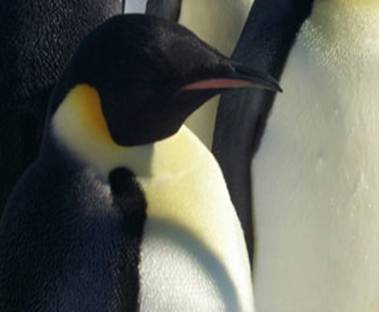
Penguins have extremely good insulation and in summer they can sometimes be in danger of overheating, particularly when they are active and the weather is fine. In this situation they often raise their flippers. The layer of fat underneath their flippers is relatively thin so heat loss is increased. Heat loss is further increased by boosting warm blood flow to this area. They can also increase their heat loss by altering the blood flow in their legs so that warm blood is circulated directly to their feet.
Seals and whales have similar adaptations to those mentioned above. They have a rounded body shape that has a small surface area to volume ratio, thus reducing heat loss. They are insulated by a thick layer of blubber and they have small extremities. All Antarctic whales migrate north in winter in search of food: in winter. In summer, seals gain heat by basking in the sun on ice floes.
Algae are the main type of plant found on land in Antarctica. Their simple, tiny cellular structure is able to withstand long periods of freezing. In summer they may be flawed and frozen several times a day. Algae can be found on and under rocks, on areas of permanent snow, and at the bottom of lakes. Lichens have been found within 400 km of the South Pole. Although they do contain anti-freeze compounds in their cells, and can function with less light and water than other plants, they recover very slowly from freezing after winter. Recently New Zealand scientists discovered lichens photosynthesising at -20 oC, the lowest ever recorded.
1. In Antarctica, is most life found on the land or in the water? Explain carefully why this is so.
2. Phytoplankton are the first living organisms in the food chain. On what do they feed?
3.
Krill
is an important link in the food chain. List the organisms that rely upon krill
for food. Why are krill less plentiful in winter?
4.
Antarctic
fish live in sub-zero temperatures. How do they prevent the water inside them
from freezing? Give two ways in which they do this.
5.
What
important task is normally carried out by haemoglobin in blood? How is it that
Antarctic fish can carry out this task without haemoglobin? What advantage is
there for these fish in not having haemoglobin in their blood?
6. List four ways in which penguins minimise heat loss.
7. How do emperor penguins keep eggs warm in winter?
8.
Emperor
penguins huddle together in winter. Explain carefully, in a proper scientific
way, what the advantage is in this group behaviour.
9.
Sometimes
in summer penguins get too hot. Describe two ways in which penguins can
increase the amount of heat they lose.
10. Give three ways in which whales minimise their heat loss.
11.
In
winter, whales migrate north because there is not enough food in Antarctic
waters for them. Carefully outline the chain of events that, in winter, results
in insufficient food for whales.
12.
Some
humans have established permanent homes in Antarctica. Where in Antarctica do
you think their homes might be? Reference to a map of Antarctica could help you
answer this question.
13.
A
group of scientists is planning to stay twelve months at Scott Base. What
special problems must they overcome in order to do this successfully? Explain
how you think they could overcome these problems.
14.
Polar
bears and other animals live and thrive in Arctic regions. Give some reasons
why no such animals are found living in Antarctica.
Worksheet 5
Surviving In Antarctica, The World’s Coldest
Continent.
Part Four: Under The Ice
Antarctica is by far the coldest continent. The world's lowest recorded temperature (-89.2o C) was
measured in 1982 at Vostok Station (Russia) on the high inland ice sheet. Mean temperatures of the coldest months are
-20o C to -30o C on the coast and -40o C to
-70o C in the interior.
Midsummer temperatures range from a mean of about 0o C on the
coast to between -20o C and -35o C in the interior. These temperatures are far lower than those
of the Arctic. How can creatures living in the sea or in lakes survive such low
temperatures? And why doesn’t the water
all turn to ice?
The answers to these questions depend in part on some very strange properties of water. The Encyclopaedia Britannica describes water as “an extraordinary substance”. For example, ice is actually less dense than water. This is most unusual: almost all substances become denser when they freeze. There is another unusual fact about the density of fresh water. As water cools it becomes denser until it reaches a temperature of 4o C. At this temperature it has maximum density. As the water becomes still cooler it decreases in density.
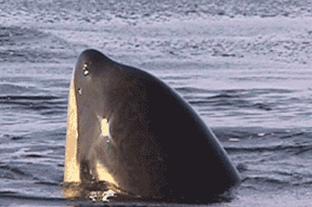
In seawater, the salt changes this
picture in two ways. Firstly, the more
salt the lower the freezing point.
Typical seawater freezes at about –2o C. Secondly, in seawater, as the temperature
decreases, the density keeps increasing until the water freezes.
The exercises
below will help you understand how these strange properties of water enable
survival in sub-zero temperatures. Copy
out the sentences in each exercise and complete them by choosing one word from
the words given in the brackets.
1.
Imagine a lake of fresh water in winter. The water on the top of the lake is exposed to the cold air above
and cools. This decrease in temperature results in an (increase/decrease) in
density. This (increase/decrease) in
density causes the water to (rise/sink) to the (top/bottom) of the lake. Warmer, (more/less) dense water then moves
up to the (bottom/top) of the lake.
This water in turn is (heated/cooled) and descends to the bottom. In this way, a
(conduction/convection/radiation) current is set up in the lake. It is easy to cool the lake down because the
(coldest/warmest) water always comes to the top where it is exposed to the
(warm/cold) air.
2. The above exercise explains what really does
happen in freshwater lakes and in seawater until the temperature reaches 4o
C. Until this temperature is reached
cooling can take place easily because (conduction/convection/ radiation)
currents help it. Let us now imagine
that water has no strange properties.
In this case the currents would continue to aid cooling until the water
temperature reaches (boiling/freezing) point.
As the top layer of water (melts/freezes) small pieces of ice would be
formed. In this imaginary situation,
these pieces of ice would be (more/less) dense than the water and so they would
(sink/rise) to the (top/bottom).
(Ice/Water) in the top layer would continue to (melt/freeze). These new pieces of ice would also sink to
the bottom. In this way eventually all the water would freeze. Once this had happened, most life would
(continue/cease).
3. Luckily, what really happens in freshwater
lakes below 4o C is different.
Suppose the whole lake has reached a temperature of 4o
C. The cold air above the lake
(heats/cools) the (top/bottom) layer of water.
Suppose it is cooled to 3o C. Now it is (more/less) dense than the rest of the water and so it
(does/does not) sink to the bottom. No
more convection currents can take place. The top water layer can continue to
lose heat to the (air/ice). Lower water
layers must lose heat by (conduction/convection/radiation) to water layers
above them. Water is actually a poor
(conductor/convector/radiator) of heat and so heat loss is (fast/slow). When the top of the lake reaches (100o
C/0o C) it freezes. The ice
that is formed is (more/less) dense than the water and so this ice floats on
the surface. Eventually a layer of ice
may be formed that covers the complete lake. Ice is also a poor (conductor/insulator)
of heat and so it acts as a good (conductor/insulator), protecting the water
below. While the top of the lake is
(frozen/liquid), the bottom of the lake may maintain a temperature of (0o
C/4o C). Thus, life in the
lake (can/cannot) continue.
4.
With seawater, warmer water is always (less/more) dense than colder
water, and so the convection currents continue to bring warmer water to the top
layer until the top layer freezes. This
layer of ice remains on the top of the ocean, being (less/more) dense than the
water beneath. Because it is a poor (conductor/insulator) of heat, the ice forms a good (conducting/insulating) layer, protecting
the water below it. Any snow that may fall on the ice further aids this
protection. As more water freezes the
ice layer becomes (thicker/thinner) and provides (better/worse)
insulation. Seasonal sea ice rarely
becomes more than about two metres thick.
As water freezes it contains very little
salt: the only salt it contains is in small amounts of seawater trapped in
pockets in the ice. As a result, the
remaining seawater underneath the ice contains even (less/more) salt. This (decreased/increased) concentration of
salt (lowers/raises) the freezing point of the remaining seawater making it
(easier/harder) to freeze. The low
temperature and the increased salt concentration of the top layer of water both
make it (more/less) dense, causing it to (rise to the top/sink to the bottom)
of the ocean. This continued convection
current keeps the water circulating. As
a result of this not just the top layer but all the water in the ocean must be
cooled to the new lower freezing point before any more freezing can occur. Once the ice becomes more than about
(ten/two) metres thick this is very difficult to achieve because the thick ice
layer is such a good (conductor/insulator).
In this way the ocean remains largely (frozen/unfrozen) and life
(can/cannot) continue in it. Further south it is (warmer/colder) and the sea
ice can be (thicker/thinner). For
example at latitude 78o S, McMurdo Sound has sea ice several metres
thick. I n spite of this, Weddell seals are able to maintain breathing holes
through the (summer/winter) by gnawing away at the ice.
 Worksheet 6
Experiment: Staying warm in cold
places.
A person working outdoors in Antarctica can lose a lot of body heat in a short time. This is because there is a large temperature difference between their body (37o C) and their surroundings (-30o C in the Antarctic interior in midsummer!). In order to minimise this heat loss, people in Antarctica wear thick insulating clothing. This experiment explores these two ideas.
1. To find how the rate of heat loss depends on the temperature difference.
2. To find how the rate of heat loss depends on the thickness of insulation.
Please read this method through completely before it you start carrying it out. It may need to be varied depending on the amount and type of equipment that you have.
1. Find three containers such as beakers or cans of the same size and shape. Into each put the same amount of hot water, the hottest water you can obtain.
2. Cover each container with a lid made of cardboard or similar. Through a small hole in this lid put a thermometer so that the temperature of the water can be measured.
3. Leave the first container as it is. Wrap insulation around the second container, including the top and the bottom of the container. Wrap the same sort of insulation around the third container, making sure that it is twice as thick as the insulation wrapped around the second container.
4. For each container, record the temperature as they cool down at one-minute intervals.
5. Continue this recording for as long as you can until the temperature is not changing much from one reading to the next.
6. Measure the room temperature.
7. Set out your results in a table like the one below. You will need more lines in your own table.
8. Graph your results on a full-page graph. On the vertical axis put temperature. On the horizontal axis put time. Plot the results for all three containers on the one graph so that it is easy to compare the three sets of results.
Room Temperature: o C
|
Time (minutes) |
Temperature (o C) Container with no insulation |
Temperature (o C) Container with single insulation |
Temperature (o C) Container with double insulation |
|
0 |
|
|
|
|
1 |
|
|
|
|
2 |
|
|
|
|
|
|
|
|
Consider just the container with the single layer of insulation.
1. When is the container losing heat fastest?
2. How does the gradient of the graph show us how fast the container is losing heat?
3. Calculate the value of the temperature 40o C above room temperature. How long does it take the container to cool down 1o C from this temperature?
4. Calculate the value of the temperature 20o C above room temperature. How long does it take the container to cool down 1o C from this temperature?
5. Read the first aim of this experiment again. Write a conclusion for this experiment based on this aim.
Now consider all three containers.
1. Which container cooled down the fastest?
2. Which container maintained its temperature the best?
3. From the results in your table, calculate the temperature decrease for each container in the first five minutes of the experiment.
4. From your graph, determine how long it took each container to reach a temperature of 30o C.
5. Reread the second aim of this experiment. Write a conclusion for this experiment based on this aim.
Worksheet 7
The Ozone Hole
The Electromagnetic Spectrum
Light is one example of electromagnetic radiation. Other examples include X-rays, ultraviolet (UV), infrared, TV waves, radio waves, and microwaves. All the energy that comes to us from the Sun comes in the form of electromagnetic radiation. Although these waves may seem to us to have different properties, to scientists they are all different versions of electromagnetic radiation, and they all have a number of important properties in common. For example, unlike sound waves, they can all travel through a vacuum, and they all travel through a vacuum with the same very high speed. This speed is 300 000 000 m s-1. Scientists have not found anything else that travels as fast as this. Even sound travels about one million times slower than light. On Earth, it is essential that we receive electromagnetic radiation from the Sun. Certainly, without the heat and light we receive, life as we know it could not exist. However, some other parts of the electromagnetic spectrum that we also receive from the Sun are harmful, not beneficial. For example, high UV radiation levels cause sunburn and skin cancer in humans and can also be damaging to other animals, plants and bacteria. We rely on our atmosphere to protect us from this radiation. In particular, we rely on a gas called ozone that is in the atmosphere.
Ozone gas consists of molecules of oxygen. However, each molecule contains three atoms of
oxygen. Normal molecules of oxygen
contain only two atoms of oxygen. Ozone
is actually poisonous. If it were found low in our atmosphere, it would be a
danger to life. However, it is found mostly between about 20 kilometres and 25
kilometres above the ground in the part of our atmosphere known as the
stratosphere. Only a very small part of
the atmosphere is made up from ozone, about 0.00004%. Luckily, even this very small amount of ozone is able to protect
life on Earth from the dangers of UV radiation. Ozone is formed from normal oxygen by the action of sunlight and
also by the action of lightning.
Actually, sunlight and lightning both create and destroy ozone: however,
normally the amount of ozone remains constant.
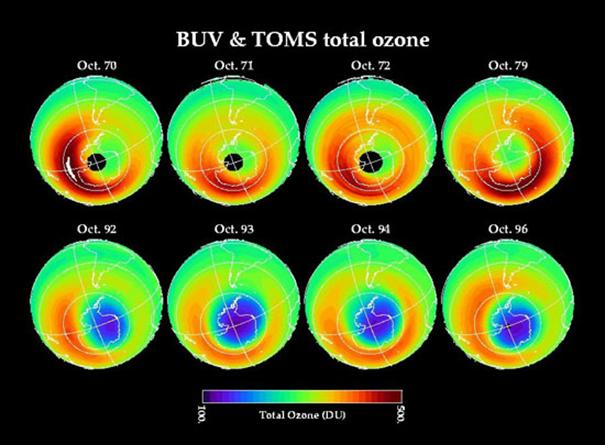
In 1985, British Antarctic Survey scientists reported that spring ozone levels had decreased by more than 30% over a ten-year period. Strangely enough, autumn ozone levels had stayed approximately the same. By 1993, spring ozone levels had plummeted to about 70% below the levels in the 1960s. Research found that chemicals called CFCs (chlorofluorocarbons) had been responsible for this rapid decline in ozone. These chemicals had been used in refrigerators, air-conditioners, plastic foams and aerosol sprays. About one million tonnes had been produced each year. CFCs are very stable compounds that can remain in the atmosphere for over 100 years. However, if they get into the stratosphere they can be broken down by UV radiation. When this happens they release free chlorine atoms that destroy the ozone. One free chlorine atom can destroy up to 100 000 ozone molecules. This research led to a worldwide agreement to ban CFCs. Ongoing studies have found that CFCs are not the only chemicals that can destroy ozone. It is important that we make sure that the chemicals that replace CFCs in our air-conditioning systems, refrigerators and so on are not harmful to the ozone layer.
The ozone hole begins to appear in spring for
two reasons. First, at this time the sunlight
is becoming stronger.
Through the autumn and the winter, chlorine molecules have been building up
in the stratosphere. The stronger sunlight in spring is able to convert these chlorine
molecules into free chlorine atoms.
Second, at this time there is a strong wind in the stratosphere
circulating around Antarctica. This strong circulating wind, called a vortex,
keeps the chlorine inside a region over the Antarctic continent. When this happens, it is possible that 70%
of the ozone layer can be destroyed in less than one month. In late spring the strong wind weakens and
allows ozone to come in from other parts of the stratosphere and so the hole
begins to fill up again. The Arctic is
affected much less in this way because no vortex forms. The process of ozone destruction is a
complicated one and is still only partly understood. However, it does seem that the very low temperatures in the
stratosphere above Antarctica do aid ozone destruction. Therefore Antarctica, being the coldest
place on Earth, is most likely to witness the greatest destruction of the ozone
layer. Such destruction is of
particular concern to people who live in countries near Antarctica, such as New
Zealand and Australia.
Problems Caused By The Ozone Hole
In spring, there is a huge reduction in the amount of ozone in the atmosphere above Antarctica. Luckily, the reduction in the ozone layer above more densely populated areas is not so large. However, scientists have calculated that even a small decrease of 2.5% in the ozone layer leads to a 4% increase in ultraviolet radiation, a 10% increase in skin cancer in humans, and a 2% increase in deaths from skin cancer. The increased UV radiation can also produce cataracts in the eyes of humans and animals.
Increased UV radiation also has an adverse effect on the ecosystem of marine life in the entire Southern Ocean. At the base of the food web there are extremely small plants called phytoplankton. During the brief Antarctic summer, these plants convert sunlight and chemicals into nourishment for themselves and other organisms in the food chain. The increased UV radiation has cut down the amount of nourishment the phytoplankton can produce by as much as 10%. This directly affects all organisms that feed on phytoplankton and, indirectly, all organisms in the food web.
Questions
1. List
seven examples of electromagnetic radiation.
State two properties that all seven examples have in common.
2.
State
two important differences between sound and light.
3. Oxygen
makes up about 20% of the Earth's atmosphere.
An oxygen molecule consists of two oxygen atoms. The chemical formula for this is 02. Copy the above information about oxygen into
your book. Write three similar
sentences about ozone.
4. Where
in the Earth's atmosphere is the ozone layer found? Why is the ozone layer so important?
5. How
is ozone formed in the Earth's atmosphere?
6. CFCs
are regarded as stable chemicals.
Explain how it is possible that such chemicals can lead to the
destruction of the ozone layer.
7.
What were
CFCs used for before scientists realised that they were so dangerous?
8.
Suppose
that, starting today, all people stopped using CFCs and all manufacturers
stopped producing them. Would this be
enough to ensure the safety of the ozone layer? Explain your answer.
9. Give
two reasons why the hole in the ozone layer starts appearing in spring.
10. Why does the ozone
hole start to fill up with ozone again in late spring?
11. In
spring, the atmosphere above Antarctica suffers a severe depletion of
ozone. However, in the Arctic, the
problem is relatively minor. Explain why this is so.
12. Why
do you think that significant ozone holes are not found over other continents
as well as Antarctica?
13. State the ways in
which increased UV radiation directly affects humans.
14. Suppose that there
was a 50% reduction in the amount of ozone in the atmosphere. Use the data given above to estimate the
increase in skin cancer this might produce.
15. Suppose that there
is an increase in the amount of UV radiation reaching the Earth's surface. What
precautions can we take to protect ourselves against this radiation? Also, what
lifestyle changes do you think people would be prepared to accept?
16. Explain how increased UV radiation can adversely affect fish and other creatures living in the Southern Ocean.
Worksheet
8.
Global
Warming
Newton
magazine in its September-October 2001 edition has an
excellent, well-illustrated article on global warming. If possible, you should
read that article. Here are some extracts from it:
The figures are indisputable: the 20th century saw the greatest increase in temperature of any century during the past 1000 years. The 1990s may prove to have been the warmest decade since records began and 1998 the warmest year. Moreover, there now seems little doubt that humans are contributing to this rise…
Global warming is real and will be with us
for hundreds, perhaps thousands, of years. In its Third Assessment Report on
the world's climate, released in January 2001, the Intergovernmental Panel on
Climate Change (IPCC) said our planet's average temperature will rise by
between 1.4 oC and 5.8 oC over the next 100 years. The
upper range represents the fastest increase in the past 10 000 years…
The IPCC... is a joint project of the United Nations Environment Programme and the World Meteorological Organisation that brings together 2500 of the world's leading scientists and experts. When it says the world is warming, everyone should take note.
The world has been warming
naturally since the end of the last ice age. What is now beyond dispute is that
human beings have been contributing to the process and speeding it up, perhaps
even overriding natural fluctuations that might tend to cool the planet…
Global warming is being caused by an increase in the concentration of greenhouse gases, mainly carbon dioxide and methane, in its atmosphere. These gases, together with water vapour, form an insulating blanket around the planet, trapping incoming solar energy.
In Antarctica, much
ice is being lost. For example, in 2000 an iceberg approximately 400 kilometres
long and 40 kilometres wide broke away from the Ross iceshelf. This is the
largest iceberg on record. Also in
2000, the Worldwatch Institute a US environmental group reported that ice on the
Western side of the Antarctic Peninsula had decreased by about 20% from 1973 to
1993.
Similar
problems are occurring in Arctic regions.
In August 2000 in an ice-free patch of ocean about one and a half
kilometres wide was found near the North Pole by a Russian icebreaker. Scientists believe that the last time
something like this happened was 50 million years ago. Scientists have also found that the Arctic
sea ice is only 40% as thick as it was in the 1960s.
Global
warming is evident worldwide. The
largest glacier in North America, the Bering glacier, shrank by two kilometres
in the two years from 1995 to 1997.
Glacier National Park, in the US, has lost more than two-thirds of its
glaciers. The US government predicts
that all the glaciers will be lost by 2030.
Mount Kilimanjaro, the highest mountain in Africa, has lost 75% of its
ice cap since 1912. All its ice could
be gone within 15 years. In South
America, Venezuela has lost four of its six glacier in the last 30 years.
Sea levels are also rising. Time magazine, in its April 9 2001 edition, reports: “the Cape Hatteras Lighthouse was built 460 m from the North Carolina shoreline in 1870. By the late 1980s the ocean had crept to within 50 m and the lighthouse had to be moved to avoid collapse” and, in South America: “Brazilian shoreline in the region of Recife receded about 2 m a year from 1915 to 1950 and more than 2.5 m a year from 1985 to 1995”. In the Pacific, Lonely Planet reports: “a rise in the ocean levels of 30 cm or 50 cm would spell the disappearance of entire Polynesian island-states”. In the Indian Ocean, rising oceans also threaten the Maldives. The highest point is just 3 m above sea level and about 80% of the country is less than 1 m above sea level. The government has built a 1.8 m high concrete wall for protection. There is also a plan to build an artificial island for up to half the country's population.
Carbon dioxide is the major contributor to global warming. Carbon dioxide in the atmosphere of Venus is the reason why Venus is much hotter than Mercury even though Mercury is much closer to the Sun. On Earth, carbon dioxide is responsible for about half of the greenhouse effect. Carbon dioxide is produced when fossil fuels are burned. However, even though world use of fossil fuels levelled off in the 1980s (due to more efficient cars and increasing use of nuclear energy) carbon dioxide levels in the atmosphere continue to rise. Joel Levine, a scientist at NASA and a professor of physics, led a group of scientists who tried to solve this puzzle. They studied over 40 000 spy satellite pictures taken of the Earth at night. They found large numbers of man-made fires. In fact, they were very surprised to find that about 1% of the Earth's surface area burns each year. In Africa, frequently farmland was burned two or three times each year. In Siberia, forests were being burned down for urban development. In Brazil much land was being cleared by burning too. About 30% of the world's tropical forests have been destroyed by burning, primarily in the last 30 years. When trees and other plants are burned, many other gases are produced too. Often these gases are also bad for our atmosphere. One such example is methyl bromide: one of these molecules in the stratosphere can destroy 2 million ozone molecules!
Industry, through burning fossil fuels, produces
carbon dioxide. Agriculture, through activities such as cattle farming and rice
growing, produces methane, another greenhouse gas. In order to measure
greenhouse gases at a global level, scientists need to operate a long way away
from industry and farming. It was for this reason that the US chose the South
Pole for global measurements of carbon dioxide in 1956. This scientific
research is still going on today. The South Pole is also the ideal place for
finding out about atmospheric carbon dioxide concentrations in the past. In
Antarctica, falling snow traps air. As more snow falls, the pressure on lower
layers turns the snow into ice. By drilling into the ice, scientists can find
out about the composition of the Earth's atmosphere in the past. The deepest
holes have been drilled to more of than 3 km depth. Since drilling proceeds at
about 10 m to 20 m a day, such drilling can take years. However, the lowest
layers can give us information about the state of the atmosphere 300 000 years
ago. This sort of research has shown us that the amount of carbon dioxide in
the atmosphere has risen from about 280 parts per million (ppm) before
industrialisation to its current figure of about 360 ppm. The amount of methane
has more than doubled in the past 200 years. Prior to industrialisation, the
levels of these greenhouse gases were quite stable.
Here is another quote from the Time
magazine mentioned earlier:
In the short run, there is not much chance of
halting global warming, not even if every nation in the world ratifies the
Kyoto Protocol tomorrow. The treaty doesn't require reductions in carbon
dioxide emissions until 2008. By that time, a great deal of damage will already
have been done. But we can slow things down... Humanity embarked unknowingly on
the dangerous experiment of tinkering with the climate of our planet. Now that
we know what we're doing, it would be utterly foolish to continue.
1.
What is global
warming? What are the two main gases involved in global warming?
2.
Explain
how human activity has led to an increase in the concentration of each of the
two main global warming gases.
3.
Choose four
different places on the Earth. State how each of these four places has suffered
a decrease in ice in recent years.
4. Global warming is likely to lead to an increase in the height of the
oceans. Name three countries that are likely to be particularly badly affected
by this. Also name three countries that are unlikely to be directly affected
much by increased ocean height.
5. A number of countries will not be directly affected by an increase in ocean height. However, these countries could be affected by global warming in other ways. Climate change is one such way. For example, England and Wales, towards the end of 2000, were subject to particularly heavy rain. The last three months of 2000 became Britain's wettest three-month period ever recorded. Describe two other always in which countries could be affected by a global warming other than increased ocean height and extreme weather conditions.
6.
Burning
forests is particularly bad for global warming. But even chopping down forests
is bad for global warming. Explain why this is.
7. How can Antarctic ice help scientists find out about the history of the Earth's atmosphere? State some facts that scientists have established after a study of Antarctic ice.
8. Why do scientists who wish to find out about global warming consider it very important to do research in Antarctica? You should give two reasons for this.
9. Carbon dioxide dissolves in water. However, as water heats up, less carbon dioxide can be dissolved in it. Some parts of the Earth's oceans are saturated with carbon dioxide now. This means that they cannot dissolve any more carbon dioxide. Explain what happens as these oceans heat up and how this will affect the rate of global warming.
10.
What is the
Kyoto Protocol? Why is it important? What is New Zealand’s stance on this
Protocol?
11. Pick one country with which you are familiar. Explain
how a temperature increase of 5 oC would affect plant, animal and
human life in this country.
Worksheet 9.
The Dry Valleys
Scientists believe
that, about five hundred million years ago, the landmasses of Antarctica,
Australia India, Africa and South America were all together. They formed the
giant and ancient land mass called Gondwana. Furthermore, scientists believe
that at this time Antarctica was near the equator. In order to justify these claims, scientists need to find
matching rock formations and fossils in these separate landmasses. In fact, the name Gondwana comes from a
region in central India occupied by the Gond people. In this region fossil strata resembling those from the other landmasses
have been found. Scientists also look
at the shapes of the landmasses to see how well they can fit together, like
pieces of a jigsaw puzzle. The pieces
do in fact fit together very well, particularly if we consider the shapes of
the continental shelves about 1000 metres below sea level.
It is very
difficult for scientists to study rocks, minerals and fossils in much of
Antarctica because 98% of the Continent is covered with a thick layer of
ice. The areas in Antarctica without
ice are called oases. These oases will
be of particular interest to scientists who want to study rock and fossil
formations. The largest of these oases
are the Dry Valleys. The Dry Valleys are also conveniently near to the research
centres of Scott Base and McMurdo Station.
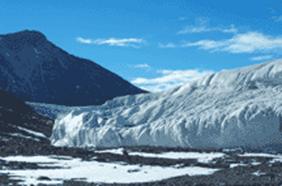
The valleys
were formed by glaciers cutting their way from the east Antarctic ice sheet
through the Transantarctic Mountains to the sea. This mountain range is one of the world's great mountain chains:
it has a length of more than 2200 kilometres, and many of its peaks exceed 4000
metres in height, even though much of the range is buried in ice. During the past thirty million years this
mountain range has continued to rise as a result of the coming together of two
large landmasses. In some places the
mountain range has been rising faster than the glaciers have been able to cut
down through it. Thus, some glaciers
have been prevented from following their historic roots and the dry valleys are
the result. However, the mountain range
is no barrier to strong and extremely dry winds that come from the great East
Antarctic Ice Sheet. These winds are so
dry that they tend to remove any moisture that is in the Dry Valleys. Adding to the dryness of these valleys is the
fact that there has been no rain in them for it least two million and possibly
four million years.
The first of the Dry Valleys was discovered in 1903 by the explorer and
adventurer Robert Scott. In fact he and two others discovered it by accident: after
visiting the East Antarctic Ice Sheet they became lost in a thick cloud and
went into the wrong valley. In The Voyage of the Discovery Scott
described it as follows:
I cannot but think that this valley is a very wonderful place. We have seen today all the indications of colossal ice action and considerable water action, and yet neither of these agents is now at work. It is worthy of record, too, that we have seen no living thing, not even a moss or a lichen; all that we did find, far inland amongst the moraine heaps, was the skeleton of a Weddell seal, and how that came there is beyond guessing. It is certainly a valley of the dead; even the great glacier which once pushed through it has withered away.
It
turns out that the Dry Valleys are not without life, although the life they do
contain is very unusual and hard to find.
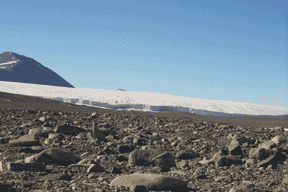
In 1976, biologists found algae, bacteria and fungi growing inside rocks
in the valleys. The rocks actually
protect the organisms against harmful radiation and loss of too much moisture. The rocks in question were porous enough to
allow some light, carbon dioxide and moisture to penetrate. Some of the plants found were believed to be
200 000 years old. Lake Hoare, in
Taylor Valley, was found to have a dense covering of blue-green algae on its
bottom, even though the lake is always covered with a layer of ice more than
five metres thick!
Mummified seals
have been found as far as forty kilometres inland, a long way from the sea for
a creature suited largely to swimming.
The extremely cold and dry conditions can effectively freeze-dry seals
and penguins. Their carcasses are then
slowly eroded by the wind. Fossilised
coniferous tree-trunks have also been found high up on ledges in the Dry
Valleys.
The
glaciers that formed the Dry Valleys cut so deep into the earth that they
exposed rock layers at least 500 million years old. These rocks are still exposed today. The yellow sandstones contain thick coal layers and plant and
animal fossils. The fossils include
freshwater fish, amphibians and reptiles.
Similar rocks and fossils have been found in Africa and India,
supporting the Gondwana theory.
The Dry Valleys of Antarctica have also helped scientists gain
extra-terrestrial knowledge. NASA judged
the valleys to be the nearest equivalent on Earth to the terrain of Mars
and so performed extensive research in the valleys in the mid-Seventies before
sending the Viking Lander spacecraft to Mars.
Meteorites falling on Antarctica are usually trapped in the ice and move
with the ice towards the coast. Where
the ice flow meets a barrier such as a mountain range, the wind scours away the
ice and reveals the meteorites. This
happens near the Dry Valleys where, in the last 25 years, several thousand
meteorite fragments have been found.
1.
How were the
Dry Valleys formed?
2.
Give two
reasons why the Dry Valleys are so dry.
3.
Why are they so
important for geologists?
4.
What was
Gondwana?
5.
List three
types of evidence that scientists could give in support of the existence of Gondwana.
6.
Some
mountains are produced by volcanic action. Give another way in which mountain
ranges can be produced.
7.
In
Antarctica, what is an oasis? In the middle of the 20th century, several oases
were discovered in Antarctica. By what means do you think they were discovered?
8.
In
the dry valleys, some plants have been found living inside rocks. Give reasons
why it would be better for and the plants to live inside the rocks have than on
the surface of the rocks.
9.
The most abundant life in the Dry Valleys is to be found in lakes. Give reasons
why you would expect
more life in the lakes than out of them.
10.
How old are the
oldest exposed rocks in the Dry Valleys?
11.
These
rocks were exposed by glacial action. There are many glaciers and rivers in the
world, and yet in very few of these places are such old rocks exposed. Why is
it so rare for rocks of this age to be exposed elsewhere in the world?
12.
NASA chose to
carry out research in the Dry Valleys because they were the best approximation
on Earth to the environment of Mars. Give three features of the Dry Valleys
that make them similar to Mars.
13.
There would
also have been some disadvantages for NASA in using the Dry Valleys in this
way. Explain these disadvantages.
14.
Why
have so many meteorite fragments been found near the Dry Valleys?
15.
Don Juan Pond,
in Wright Valley, is only 10 cm deep. It is so salty that it never freezes,
even when the temperature gets as low as -50o C. Why do you think
this lake is so salty?
16. The Lonely Planet Guide to Antarctica, in its section on the Dry Valleys, states that "tourists generally fly by helicopter into Taylor Valley, the most accessible from the Ross Sea. Large sections of the others are protected areas under the Antarctic Treaty, and access is restricted or forbidden, even to scientists." Why do you think the decision has been made to restrict access to the Dry Valleys so much?
To go to Fiona's worksheets click on her name.